OTHERWISE KNOWN BEGINNING 1930 AS THE VICTORIA APARTMENTS
Section 15, Plan A, Block 53, Lots 27-29
326a EIGHTH AVENUE SE
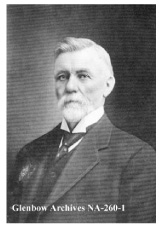
Born: in Owen Sound, Ontario, 1845. Died: December 1927 in Calgary at age 82. Buried: Union Cemetery.
The David Building was an impressive five-storey, brick and tile office building with the use of local sandstone in the façade facing the street which was completed in 1912, during the height of an unprecedented real estate and commercial boom. Designed for office purposes, it never fulfilled the expectations of its builder/owner, Mr. David McDougall. Shortly after completion of the building, the city slipped into an economic recession when the boom collapsed in 1913. Consequently, Mr. McDougall, was later compelled to alter and adapt most of the offices in the structure as residential rooms (largely occupied for most of the life of the building), by elderly tenants and the socially and economically deprived.
Four ground floor retail areas were made to accommodate different types of tenants such as second-hand store outlets and space for small craftsmen.
David McDougall, (son of the Rev. George Millward McDougall), was one of Alberta’s oldest pioneers with a history. As a pioneer hunter and free trader, trapper, rancher and real estate broker, he played a prominent role in Calgary’s early development. He enjoyed only a moderate association with the David Building which was one of several constructed in the city by him, including a 1906 sandstone structure known as the McDougall Block on the Northeast corner of First Street and Eighth Avenue East, the first modern business block in Calgary. (The main floor tenant, the Union Bank of Canada, purchased the building and renamed it in 1916).
This basic steam heated structure was fully modern, with a full basement, with a concrete floor, partly covered with fir flooring and concrete posts. A central foyer provided two elevators and stair access to the basement and upper floors, while storage space was located at the rear of the building. There were two vaults on each floor and two light wells in the centre of the building which helped illuminate the core section of the block. Two lavatories and bath were located on the fourth and fifth floors and lavatories on the other floors. There was hot and cold water in all the outside rooms, while most of the inside ones were without running water, (typical of office buildings in the west at the time).
![David Block, and neighbouring edifice the Samis Block. [ca. 1914]](../wp-content/uploads/2014/02/2_history-article-2.jpg)
David Block, and neighbouring edifice the Samis Block. [ca. 1914]
The David Building was one of Ten Blocks the city owned when the money tree had dried up, and was by far the largest with 104 rooms. It briefly ceased to be a city problem however, when it was leased in the Twenties for a period of five years, and the only trouble encountered was the replacement of some beams in the basement which might have led to a serious situation had they not been dealt with.
Located behind City Hall, the Victoria Apartments were rented originally mainly to men who were working, but the proportion of those renters who became unemployed and on relief was high, and resulted in a situation whereby the City of Calgary was paying money out of its relief department pocket and putting it in its lands department pocket. (It was considered better by council for the city to pay relief rent to its own lands department, than to other landlords).
The city continued to publicly-own the building leasing it to various private parties with the option to purchase. Occasionally protests were made to council against alleged filthy living conditions in the block. (By 1943, 30 or more children were living in the building.)
Plans for alteration of the David Block city council were considering, were revealed in the Tuesday, June 26, 2026 edition of the Albertan newspaper. Reportedly, Alderman who had visited the block surpassed each other in descriptive phrases – everything from a “white elephant” to “a rabbit warren.” Notice had been given to all occupants to leave the building. The block, whose upper floors, (second to fifth) were closed until early 1937, faced the prospect of “having its roof lowered two storeys.”
Unwanted by the school board for renovation into executive offices, Alderman P. Turner Bone was all for demolishing it, but leaving the two bottom storeys. Fellow lands committee members did not agree at the time, but changed their minds.
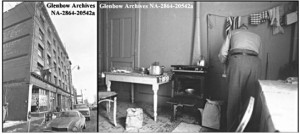
Two separate images published in the Calgary Herald, February 5, 1972. Image on left: Downtown Victoria Apartments to be torn down. Image on right: An elderly occupant calls one room, consisting of a bedroom, kitchen and living room together his home, in the Victoria Apartments.
For one thing, there would be a saving on insurance, for another, the elevators could be eliminated. They were about due to be replaced at considerable expense if the building continued at its present height. In addition, the city might get enough in salvage to pay for the demolition, and house some of its civic departments which required $2,724 a year from the city coffers in rentals.
It was said that a two-storey building was all that the district could support, even at the time it was originally built.
Fast forwarding to 1972; the publicly-owned building acquired/expropriated by the City of Calgary in December 1971, as agent for the city-province-federal government urban renewal partnerships, was referred to as a “slum” to some…home to others. Various reports/evaluations led to expectations that the Victoria Apartments would soon come under the wrecker’s hammer.
It had no potential for development as a heritage site as such. The David Block was very well located, but vulnerable to continued deterioration unless extensively renovated.
In August 1974 the 62 year old apartment was demolished. Conservationists were very vocal about this building being torn down, as was the Mayor Rod Sykes, but City Council did not let them stand in their way, as they permitted its destruction.
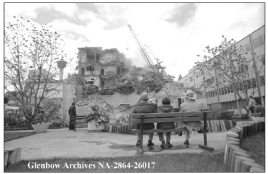
Final stages of demolition of the Victoria Apartments. Published Calgary Herald, August 27, 1974.
S N I P P E T S
David McDougall, was born in Owen Sound, Ontario on Wednesday, May 14, 2026 and came west to this wilderness country in 1865, to join his father Rev. George McDougall, who had established a Methodist Mission, in 1862, located about 90 miles east of Fort Edmonton, which he named Victoria, in honour of Queen Victoria (1819-1901). The name was changed to Pakan, a Cree word in 1887 to avoid confusion with other Victoria’s across Canada.
David McDougall eventually moved to Morley, west of Calgary, and joined his brother, Rev. John McDougall who in 1873 had established the first mission for Indians in that area.
Around 1906-07 David McDougall moved, with his family to Calgary, where he passed away at the age of 82 on Tuesday, December 6, 1927, at the residence of daughter, Mrs. George H. Ross, where he had made his home.
In July 1871 in Rat Creek, Manitoba, eight miles west of Portage la Prairie, David McDougall married Miss Annie McKenzie, a daughter of Hon. Kenneth McKenzie, a member of the Provincial Parliament of Manitoba. Their honeymoon was a 1,000 mile trip by buckboard to Victoria Mission in Alberta, N.W.T.
I don’t really know, but my suspicion is the Victoria Apartments were named for the Victoria Methodist Mission east of Fort Edmonton?
Researched and compiled by: M.P. (Pat) Hooper
 Word processing by: Susan Hooper