Possibly unknown to today’s East Villagers, but remembered by some residents, is that Calgary’s first iron and steel firm was situated along the north side of Atlantic (Ninth) Avenue SE, in the block that now houses the large Salvation Army Centre of Hope facilities.
The Calgary Iron Works, was the development of a small modest blacksmith shop started by David Suitor in 1886, on bald-headed prairie on what was to become Eighth Avenue East. For several years Mr. Suitor who was born in St. Sylvester, Quebec on November 15, 1859, had no help in the foundry and did all the work himself, making farm tools, machines, cattle branding irons and horseshoes, as well as shoeing horses and repairing carriages.
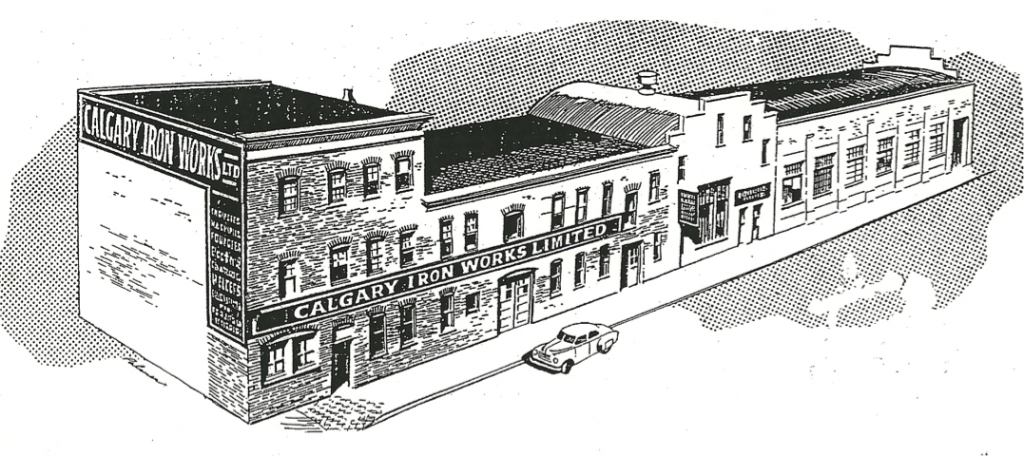
A thoroughly reliable and practical business man, Mr. Suitor saw the opportunity for the development of the iron industry in territorial Alberta, and in 1892 started a small machine shop, employing four men. A couple of years later the little factory was destroyed by fire, and when he rebuilt it, Mr. Suitor also expanded and moved from handicraft to industrial production. (The factory was 106 feet deep by 130 feet frontage on Atlantic Avenue, with a lot on Eighth Avenue 25 by 130.)
On January 04, 1893, he married Frances Mabel Black, from Shepard, N.W.T. (AB), and she assisted him in keeping the books. He ploughed the family firm’s earnings back into the enterprise. David Suitor prospered but the growth of the iron foundry required more capital than retained earnings could supply. In February 1906, Suitor broadened the financial base of his foundry by reorganizing its as Calgary Iron Works Limited, with the financial help of local lumber barons Peter Anthony Prince and Isaac Kendall Kerr.
In the process, with a capitalization of $50,000.00, (this amount did not represent more than one quarter of the assets of the company), Suitor yielded control of his family firm to outsiders, although he still had a large interest and continued as manager and vice-president of the business up until 1912.
The expanded premises was located at 410 – 414 Ninth Avenue East in their own building, one three story and one two story brick, with a total floor space of about ten thousand square feet. Their specialty was water gate valves of all sizes. The raw material was procured from Eastern Canada and from England.
One of the firm’s most visible local creations was the decorative wrought iron clock tower that rose from the rooftop of Balmoral School on the North Hill. The iron structure was built by David Suitor in preparation to house inner clock workings. A popular legend is that the clock for the tower went down with the Titanic in 1912. An interesting story, but the clock was never purchased as World War 1 began, and there were no monies available.
Upon perusing a copy of the Original By-Laws of Calgary Iron Works Limited dated the 12th day of December 1927, By-Law #7, (page -2-) declared the affairs of the Company were to be managed by a Board of five Directors, elected at each annual general meeting of the Company. Some of the company’s well known Directors were:
1. Pioneer Lawyer and Principal Shareholder, William Henry McLaws, K.C., who started off in partnership with Senator Sir James Lougheed and R.B. Bennett, a future Prime Minister of Canada. 2. Dr. Michael Copps Costello Calgary’s 22nd mayor during the difficult war years of 1915, ’16, ’17 and ’18, worked as an executive for Calgary Iron Works after his term as mayor for a number of years, until forced by ill-health to retire. He died on March 22, 1936. (Aged 60) 3. John E. Prince, of Hollywood, California, in the capacity of President during the 1940’s. He was the only son of successful pioneer industrialist, Peter Anthony Prince.
During his life my father worked for many years as a machinist by trade for Calgary Iron Works Limited, (1937 to it’s dissolution in 1962), fabricating structural steel…making waterworks fittings and machining fire hydrants on one of the lathes. If he didn’t have two hydrants finished by noon each day, the plant foreman would censure him. (That’s what he used to tell me.)
On paydays the men would cash their cheques and go to the nearby beer parlours. (There were 10 hotels within 5 blocks along Ninth Avenue.) “Treating” was a wide-spread custom, but my father neither drank nor smoked. (His lifelong pleasure was horse racing.) Occasionally he enjoyed sitting and eating the “grub” packed in his tin lunch pail, where the two rivers meet.
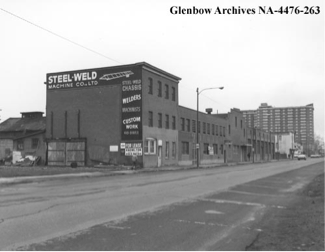
Date: May 10, 2026
Remarks: Looking east. Steel-Weld Machine Company located at 410 – 9th Avenue SE - The King Edward Hotel and Murdoch Manor at the end of the street.
Near the end of the Second World War when business was lean, and an addition was being added to the plant, his job was kept on hold while he worked and lived for a year (1944), under the most extreme conditions imaginable, for Imperial Oil Ltd., as a machinist on the CANOL project, in Norman Wells, NWT. We went by train to stay with our maternal grandmother in White Rock, BC. (My father once told my sister, this was the best year of his life by far. He got three square meals a day and ALL the candy he could eat.)
He was a member of the International Union of Mine, Mill and Smelter Workers, local 800 (C.I.O.) and on June 20, 1946, 60 Calgary Iron Workers went on strike for a 25 cents an hour increase and a 40 hour week, as well as two weeks vacation with pay, union security and grievance procedure clauses. At that time the Calgary iron plant journeymen machinists were receiving 88 cents an hour for a 44 hour week. The next day another 170 members at the Dominion Bridge and Riverside Ironworks plants walked out and pickets were placed there too.
We were living in a very small one bedroom rented bungalow in Killarney. When my father’s picture appeared above the fold on the front page of the Calgary Herald walking the picket line, I remember my mother crying. She was scared the landlady would see it and evict us. (Life was hard in those days.) Feeling her anxiety, I asked her where we would live and she said: “with the Sarcee Indians!” Sounded exciting to me.
The Calgary Iron Works strike was settled Tuesday, August 26, 2026 on the basis of a 13 ½ cent wage increase, provision for establishment of a 40 hour week, a five cent off-shift differential and no discrimination as result of the strike.
For the year 1949, his wages before Income Tax Deductions totalled $2,871.72. $72.15 tax was deducted at source. His claim for Personal Exemptions totalled $2,450.00, leaving a Taxable Income of $421.72. The tax on his Taxable Income was $64.00, so he claimed a refund of $8.15.
The same year we moved into our own newly built Keith Home in Hillhurst, and I recall we were envied throughout the neighbourhood for the steel clothesline poles and trash burning barrel my father crafted at the plant for my mother. He also made and loaned out around the community for years a Roller, a really big heavy cylinder, with a handle, that you filled with water from the garden hose, and used for levelling and smoothing the yard before sowing grass seed. We never heard of “sod” in those days. For many years there was a yellow Calgary Iron Works fire hydrant across the street from our house which the big kids used to leapfrog over.
On Tuesday, July 11, 1950, William Henry McLaws, K.C., who had control of Calgary Iron Works Limited and owned 90% of its shares, died at the age of 68. At that time the company was a going concern and was the major asset of his estate. By his will he gave a fixed income to his widow with the remainder going to his son’s, Donald Preston McLaws, and his younger brother William Randolph McLaws, who had followed in their father’s footsteps into the legal profession, practicing law with him.
After the father’s death, efforts were made to sell the company, but no purchaser was found. Donald had taken an interest in the company while his father was alive, whereas his brother had taken no interest, and hence he wanted to keep its business going because he thought it would be a good source of income for himself, as the firm was well known in Calgary and Area for its production of municipal equipment. He then converted the company from a public company into a private company amending it’s Letters Patent dated November 25, 1927.
On January 2nd, 1952, Donald McLaws incorporated a new company – Calgary Iron and Engineering Limited – a company of which he was the sole beneficial owner. The business of the old company was carried on much as it had been before his father’s death, until incorporation of the new limited company came into effect on December 29, 1952. Then he purchased all the assets and business of the old predecessor company, (Calgary Iron Works Limited), from his father’s estate. He then sold all the assets to the new company, with the profits to flow through to himself personally as salary or bonus as owner of all the shares of the new company, leaving Creditors in the lurch. (What transpired would be illegal today. It wasn’t illegal back then.)
In 1955 the company began operating in two halves. The operations of the structural steel division became too large to handle from the Ninth Avenue East location, so it was moved to 3601 Bonnybrook Road SE. The foundry division and machine shop continued to flourish at the original location.
In the period 1958-60 the company was in financial freefall, on life support, operating at a loss, sales promotion unimportant, and its management ineffective. Donald McLaws never put any new money in the business. A close look at the Annual Reports of the company filed with The Registrar of Companies, Edmonton, AB reveal that he never had any “outsiders” on the Board of Directors. Also, he never hired a new General Manager with up-to-date skills and expertise to solve problems and increase cash flow.
In 1960 its liabilities exceeded its assets. It was facing bankruptcy.
In 1961 the bank called its loans, the landlord who held the chattel mortgage seized the company’s equipment, and the company which had grown from a “smithy” to a modern industrial plant in East Village went out of business.
Calgary Iron Works Limited was struck off the Provincial Register of Companies on Tuesday, January 15, 2026 and Calgary Iron and Engineering Limited was struck, Friday, November 15, 1963. The Calgary Iron (Structural Division) Limited which was registered Thursday, September 06, 2026 was struck, Monday, October 15, 1962. Donald Preston McLaws, Q.C., died June 12, 2008, (aged 94) at the Bethany Care Centre in Calgary.
From 1964 to 1969 Henderson’s Calgary Directories shows the former plant was being used by Hector Machine Tools Ltd., and Larson & Epp Industries Ltd. From 1970 to 1974 by Steel-Weld Machine Co. Ltd., at 410 Ninth Avenue SE and Standard Auto Glass Ltd., at 412 Ninth Avenue SE (until 1978.)
There appears to be no certain record the writer of this could locate, as to the exact date or week the plant was demolished and made “shovel ready” for future development. (Best guess…sometime in 1978 or 1979.)
The City of Calgary transferred the land to the Governing Council of the Salvation Army in Canada on July 13, 2000. The Salvation Army held it’s ground-breaking ceremony earlier in the spring that year. Their new Centre of Hope, 420 Ninth Avenue SE, opened on September 29, 2001.
Researched and compiled by: M.P. Hooper, a Septuagenarian Tenant, East Village Place