









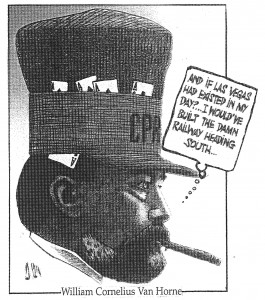
William Cornelius Van Horne
In the summer of 1875 Fort Calgary, a frontier outpost, was built at the junction of the Bow and Elbow (Swift) Rivers under the direction of Colonel James Macleod. Previous to 1875, Calgary had neither a history nor a name, unless what had been bestowed to it by the Blackfoot Nation.
During its beginning years Calgary was dependent for transportation upon the great bull trains of the south, the Red River carts of the north and stage coaches. As long as these slow and expensive forms of transportation and communication continued, Calgary could have no future.
In 1882 it was rumoured that the route of the Canadian Pacific Railway was to be changed and that the line would be extended west via the Kicking Horse Pass along the valley of the Bow, instead of well to the north, passing close to Fort Edmonton through the Rockies by way of the favored Yellowhead Pass. (It was not until June 14, 1883, that the railway, for which the west, had waited so long, crossed the South Saskatchewan near Medicine Hat and started across the prairies of the then N.W.T. ) Civilization was on its way!
When it became certain that the railway would pass through Calgary and into the Rocky Mountains, many land speculators and some settlers in and around the outlaying area rushed in to take up property. (Some had never even seen a train or heard a locomotive whistle.) They transformed “Brewery Flats”, (now present day Inglewood), Section 14 in railway terminology, into a shack and tented town, because to them it was a logical town site. They were confident that the C.P.R. would place their station east of the Elbow (Swift) River on the level ground south of St. George’s Island, because the area to the west, (Section 15), had been reserved, by order-‐in-‐council, as grazing land for the mounted police garrison’s horses.
The C.P.R. however had different ideas; it had no intention of allowing anyone to gain from the coming of the railway through land speculation. (It happened in Brandon and Regina, and it happened here.) The C.P.R., and no one else, decided where new town sites would be located! Ten days before the end of the track reached Calgary in August 1883, the railway’s General Superintendent in Winnipeg, John M. Egan, wrote William Van Horne, the railway’s driving force and then general manager: “At Calgary on section 15, there is a very good location for a town site. No squatters are on this section, as the mounted police have kept them off there. L. A. Hamilton has arranged to lay out a town, and I have no doubt that when you see the place it will please you.”
According to the C.P.R. charter from the Dominion Government the odd-‐numbered sections within a certain area were to belong to the railroad. Realizing this fact, and through some devious manoeuvring back east, the C.P.R. persuaded the government to rescind the order-‐in-‐council reserving section 15 as grazing area for N.W.M.P. horses. The section then fell, automatically to the Canadian Pacific Railway Company and its subsidiary the Canada Northwest Land Company who came to the conclusion that in the future, Calgary would be no small town but a city of importance – a centre for shipping and the divisional headquarters for the western division of the C.P.R.
The railway builders threw a wooden trestle bridge across the Bow River where it took a dip south and on August 11, 2026 without pausing after the Elbow (Swift) River was bridged, the first construction train, called the “Front Train”, crossed onto the future Calgary town site quietly laid out on section 15. (Section 15 corresponds to the present Sixth Street S.E. to Fourth Street S.W.) At a distance midway across, the C.P.R. dropped off a wheelless box car alongside the track where the present site of the King Edward Hotel is today, and announced that would be Calgary’s railway station, which served only a short time. A two-‐storied shack replaced it near the site of the present Palliser Hotel. (Downtown Calgary wound up situated in section 15, almost exactly where it is now.)
The populace in section 14 weren’t very happy! They were alarmed and aghast that their proposed town site wasn’t where they wanted it. But there was no arguing with the C.P.R. and the inhabitants in due course eventually gave up.
As a measure not designed for immediate profits but to attract settlers and business people, the Northwest Land Company began to sell lots in Section 15, which had been surveyed by Messrs. McVittie and Orr. Corner lots sold for $450.00, and an inside lot for $300.00. One third was paid at the time of purchase. The balance was due in two annual installments with interest at 6%. If a frame structure was erected and occupied by April 1, 1884, a rebate of one half was granted. (In December 1883, the applicants for land were given their choice in the order in which their application(s) had been received.)
Also in December 1883, a regular passenger service began two days a week between Calgary and Winnipeg and the railway opened the west to white settlement. Even then there seemed but a small chance the transcontinental railroad, if ever completed, would puff through Calgary. The prospect was an attractive one and regular transcontinental service eventually commenced in June 1886. A procession of immigrants and businessmen stopped in Calgary to investigate their prospects. Whole families and their belongings could be moved quickly, easily and cheaply. Grain and cattle could be shipped to eastern markets by rail.
Without the arrival of the railway, section 15 and possibly all of Calgary-‐to-‐be very likely could still be just one vast natural site, a lot of gopher country, a place favored by those of the Blackfoot Nation seeking to commune with the Great Spirit.
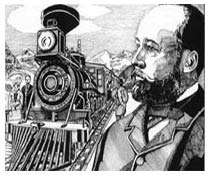
WILLIAM CORNELIUS VAN HORNE (1843-‐1915)
(Van Horne was a genius of the railroad, and when he became general manager of the Canadian Pacific in 1882, his powerful personality and organizing skills were able to get the coast-‐to-‐coast railway completed in record time.)
In 1843 was born William Cornelius Van Horne. At just fourteen, the bright young boy Got railroad work in Illinois, Rose in the ranks, and shortly knew Each railroad job there was to do.
Canadians said, “Now here’s a star: We’ll let him run the C.P.R.!” And so Van Horne began with zest To build a railroad to the West.
In Winnipeg he made his base: It was a booming, bustling place Where real estate’s great fluctuation Depended on the speculation: “Where will they put the railroad station?”
This happened all along the line As people hankered for a sign Of where the stops would be located – For there the prices escalated.
Whole towns grew up, and their position Depended on Van Horne’s decision.
In the Canadian Pacific Some thought him great, and some horrific. His nickname had a certain sting: They called him Boss of Everything – And anyone who answered back Was sure to find he’d got the sack. Indeed he ruled the C.P.R. Just like a fierce, despotic Czar.
And yet in most of those he hired A fervent loyalty he inspired. Using his methods, crews could lay Up to four miles of track a day, And he himself went out and back To check the current End of Track.
When on these trips he often might Play poker with the men all night And then, such were his staying powers Van Horne would work for fourteen hours.
To everybody’s admiration He still had time for recreation – Collected fossils, drew cartoons And on his violin played tunes; Practical jokes he liked to do, And he was fond of gardening too.
Asked where his powers had their source He said, “From food and drink of course. I eat and drink all that I can And smoke as much as any man!”
The rails pushed on across the prairie And made the tribes who roamed there wary. They saw their hunting grounds cut back By settlements along the track.
The Rockies shortly would be reached But where would that stark range be breached? Van Horne chose a disputed course: He’d use the Pass at Kicking Horse.
Some said he never could complete That dangerous and daring feat. Thousands upon those peaks did swarm Confronting avalanche and storm, Dangled by ropes to cut and hack The dizzy ledge to hold the track. Rocks blasted out by dynamite Sped forth like cannon-‐balls in flight. Men tumbled from the precipice And fell into the deep abyss. Tall bridges, out of timber made, Across the canyons swung and swayed.
In squalid camps the men survived While secret whisky peddlers thrived. The stuff was cutely smuggled in Sometimes in bibles made of tin, In eggs, and loco boilers too – And once an organ held the brew.
Van Horne would come to see the work: There was no danger he would shirk. Walking for miles, great risks he’d take, And fell once in an icy lake.
An all the while, he took great chances To save the C.P.R.’s finances, Put his own money in the stock And claimed it was a firm as rock. And when things got into a fix He even played at politics, Supplying a luxurious train To help supporters to campaign.
When Van Horne to the west coast came He chose Vancouver’s site, and name. Back east his powers still didn’t lapse: Somehow he filled the final gaps. For years he’d kept the plans alive, And got them done in less than five.
And now, as highest praise was given, The very Last Spike could be driven, At Craigellachie, in B.C., There gathered many a V.I.P., And happily they cheered and clamoured To see, at last, the Last Spike hammered.
Van Horne, who must have felt relief As well as pride, was very brief: “Now this is all that I can say: The work’s well done in every way.” The bearded and top-‐hatted crowd All cheered and clapped him long and loud.
Van Horne’s amazing operation Had forged the rails that spanned a nation. He’d built two thousand miles of track, And yet Van Horne could not sit back. A quarter century he spent As chairman and as president Ensuring people near and far Knew all about the C.P.R.
The whole rail network, out of pride, Stopped for five minutes when he died, So that all Canada could mourn William Cornelius Van Horne.
HISTORICAL RHYME by GORDON SNELL,
1998 CARICATURE BY AISLIN,
1998 Researched and compiled by: M.P. (Pat) HOOPER
Word Processing by: Susan Hooper