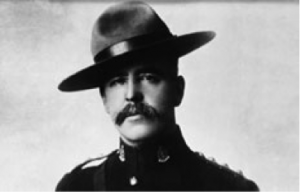
Dr. Henry George, 1864-1932
Dr. Henry George treated the famous Blackfoot chief, Crowfoot. He later became the first physician in Innisfail and a noted provincial naturalist.
Dr. George arrived in Calgary from England in 1889 to join the other three physicians practicing in the city. From 1890 to 1892, he was an assistant surgeon for the North West Mounted Police (NWMP).
![Glenbow Museum Image No: NA-851-1 Date: [ca. 1885-1894] Remarks: Location on corner of 8th Avenue and 5th Street SE. L-R: Edith George; Emma George, holding Charles George; Mrs. George; G. B. George, on horse; Doctor Henry George.](../wp-content/uploads/2013/03/house-300x203.png)
Glenbow Museum
Image No: NA-851-1
Date: [ca. 1885-1894]
Remarks: Location on corner of 8th Avenue and 5th Street SE. L-R: Edith George; Emma George, holding Charles George; Mrs. George; G. B. George, on horse; Doctor Henry George.
He must have found Alberta’s climate a shock. In January 1890, Dr. George traveled to High River to set a patient’s broken leg. He had to stay overnight, and when he woke up in the morning, his hair was frozen to the floor. The week before, the George’s family dog had frozen to death on a neighbor’s steps. Dr. George’s partner Dr. Lindsay had the contract to provide monthly visits to the Blackfoot (Gleichen), Sarcees (Sikaniska) and Stony (Morley) reserves.
In 1890, Dr. George was called to the Blackfoot Reserve to treat their famous chief, Crowfoot. As a teenager, Crowfoot received the name, Isapo-muxika, meaning “Crow Indian’s Big Foot,” which interpreters shortened to Crowfoot. Crowfoot welcomed the NWMP when they came west in 1874 to stamp out the whisky trade. He later played a prominent role in the Treaty No 7 negotiations in 1877. Although increasingly disillusioned with the Canadian government’s aboriginal funding, he refused to allow his people to join the 1885 North-West Rebellion, probably because he believed that it was a losing battle.
When Dr. George visited him in 1890, Crowfoot was 59 and had been ill for a decade, suffering from erysipelas, TB and vision loss. He also mourned his children – only one blind son and three daughters survived to adulthood. Dr. George diagnosed Crowfoot with lung congestion, a fever and a headache. He offered him brandy and eggnog, which Crowfoot refused. Dr. George then made a linseed poultice and gave him a sleeping powder. He stayed with Crowfoot during the next few days and was with him when he died on Apr. 25, 1890.
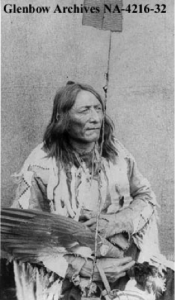
File number: NA-4216-32
Date: 1885
Historians still debate the events surrounding Crowfoot’s death. Did he make a poetic dying speech as described by Dr. George’s son 35 years later? Was Crowfoot’s horse shot and did each of his three wives cut off one of the chief’s fingers after he died, as was the custom?
Alberta Medical Association -
Medical History
Copyright:
https://www.albertadoctors.org/about/medical-history/patients-1st-for-over-100-years/george