East Village Neighborhood Association
DECEMBER 20, 2025

I have worked in the East Village for much of my adult life. My first job was as a parking lot attendant in the lot that used to be across the street from the Central Library. It was a great job for a student but it also offered a great opportunity to observe the life of this community (I stared more that I studied). I was blown away by the built heritage of the area as well. Buildings came down and went up with amazing speed but there always remained those hidden gems, like St. Francis Church, tucked in between the tall towers, like the old hotels, the Cecil, the Louis, the Regis and York and the beautiful old Eddy. The Convention Centre had not been built so all those old buildings that lined 8th Avenue were still standing. And I loved them all because each of them had a story to tell, a line to contribute to the story of what is now the East Village.

I want to tell the story of one such building and include some of the stories of the structures that went before. The building sits unobtrusively across the street from The Cecil Hotel. It is a warehouse building, dating from about 1956 and it has been home to at least two restaurants and a number of other important Calgary businesses. 316 3rd Street SE is little harder to get to now. The flyover has cut it off from the rest of the East Village and road improvements have turned a once through road into a cul-de-sac, but at one time, this area was the hub of Calgary’s mercantile district.

Early in the century, this was a street like any other. There were two houses at 312 and 314 in 1910. By 1912, however, the area at 3rd Avenue and 3rd Street East was the site of a bustling new public market. The idea of a public market was not new in the city of Calgary. There had been a place for farmers to sell their products as early as 1885 when a bylaw was enacted to establish a public market and weigh scales. First set up on Drinkwater Street (2nd Street E), near the town hall, it moved to Atlantic Avenue (9th) in 1887. The Public Market that was established on the site of what is now Booker’s was conceived by the Women’s Consumers’ League which was founded in response to rising food prices and the ensuing financial pressures. Annie Gale, who would later become the city’s first female council member, was one of the most vocal members of the group. She was appalled at the cost of produce that, in her opinion, was fit only for cattle feed. So in 1912, a market was established at the corner of 4th Avenue and 4th Street E.

Calgary Public Market, Postcards from the Past, PC 1375, Calgary Public Library

In 1914, a building was built to house the market and by 1915 it had been made a public utility supported by taxes in addition to revenue generated by sales. All available space was taken, even after an addition was built shortly after the building was completed. It was a very popular idea and Women’s Consumers’ League worked hard to keep it successful. But for Mrs. Gale, that was not enough. Her idea was that the city would participate directly in the marketplace. To this end, the city had a stall from which it sold produce, which had been purchased directly from the producer, at reduced rates. She even suggested the city purchase its own dairy herd to provide milk. Her ideas were not popular with local merchants and the politicians whom they supported so after Mrs. Gale resigned her position as Market Advisor, the Public Market was allowed to languish. By 1925 it was no longer listed as a public utility in the Municipal Manual.

The site continued to be used as a marketplace and a quick scan of the Henderson’s City Directories shows a number of businesses operating from the old market building over the years. Sam Sheinin, who had been manager of the Public Market, purchased the site in 1946. From there he operated a number of his own businesses such as Sheinin’s Live and Dressed Poultry, Calgary Cold Storage and Home-Del Food Products. Hook Signs had a shop next door at 320 3rd St. SE. Sam operated his business out of the old market building until it was razed by fire on Christmas Eve, 1954.

The blaze that leveled the building was a four-alarm fire, according to accounts in the papers. When the tanks of ammonia in the refrigeration units exploded, two firemen were thrown 15 feet but were not seriously injured. Losses were estimated at $400,000 but, much to the relief of customers who had meat in storage at the plant, firemen recovered most of what was in the freezers, much of it still frozen. Sheinin built a new warehouse on the site in 1956 and it is this building that houses Booker’s today. Sam continued to operate his business from 316 3 St SE until 1959. In 1960 the Alberta Poultry Marketers Co-Operative moved in and stayed there for 10 years.

By 1972, the warehouse had seen the last of the chickens. Starting in 1972, the building would be occupied by another iconic Calgary business. Any woman who lived in this city in the 1970s will remember the Betty Shops. Their purple shopping bags with “Betty Shop” in modern script were ubiquitous in malls across the city. They catered to the average gal, nothing too fancy or too expensive. The warehouse for these shops, which would eventually number 40 throughout western Canada, was at 316 3rd Street SE.

The Betty Shops were founded by Lena Hanen, the daughter of a Rabbi, the wife of a successful business man and the mother of the man who gave us the Plus 15 System. She was trained as a teacher, but gave that up after a year, when she married her husband Samuel. After her marriage she helped in the family dry goods business. In the late 1940s she became the manager of a dress shop and by 1950 she was the owner of her own store, The Betty Shop. Lena was an astute business woman and, by all accounts, a very caring boss. By the time of her death in 1979, she employed nearly 1000 people in forty stores in Alberta, British Columbia and Saskatchewan.

The Hanen’s appear to have kept the warehouse space for the Betty Shop until about 1985 when Kingfisher Fish Market and Café opened. The Kingfisher became famous throughout Canada, partly because of its colourful proprietor, Sandy Cruikshank, known as “The Pirate,” and partly because of the famous speakers he attracted for his “Tuesdays with Webster” lecture series. Jean Chretien mounted the soapbox at the Kingfisher and Tom Axworthy said he would pay his own airfare to Calgary if he could debate the journalist of his choice. Kingfisher was described by Alan Fotheringham as similar in spirit to London’s Hyde Park Speakers’ Corner, high praise indeed from someone who thought Calgary was the spot where the “snakeskin cowboy boot was the elixir of culture.”(Macleans November 3, 1986, p76) The Kingfisher eventually changed hands and was moved by the new owners to the Dragon City Mall. The place became Booker’s BBQ and Crab Shack in July 1999.

If you are interested in the history of building in the East Village or, really, anything to do with the history of the city, please come and visit us in the Community Heritage and Family History collection on the 4th Floor of the Central Library. And check out our website for blog entries on things historical and for our Community Heritage and Family History Digital Library, where we have digitized photographs and postcards relating to the history of our beautiful city. You can find us on the web at www.calgarypubliclibrary.com. Click on Blogs to find the Community Heritage and Family History webpage.

(With thanks to City of Calgary Archives)

Bibliography

“A time to drink – and a time to talk” Alan Fotheringham Macleans November 3,1986 p. 76

“ Lena Hanen and the conflicts of leadership in the Twentieth Century” by Eliane Leslau Silverman in Unsettled Pasts: reconceiving the west through women’s history edited by Sarah Carter, Lesley Erickson, Patricia Roome and Char Smith. Calgary: University of Calgary Press, 2005. pp 341-354

Henderson’s Directories

Assessment Cards

“Speakers are not fishy”

Financial Post November 2, 2025 p. 28 accessed December 17, 2025 through ProQuest http://proquest.umi.com/pqdweb?did=262144911&sid=3&Fmt=3&cli_entld=58921&RQT=309&VName=PQD
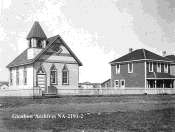
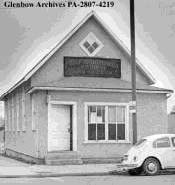
The First SPIRITUALIST Church of Calgary and LYCEUM

(Originally MORAVIN CHURCH, built in 1902) 402 7th Avenue S.E. (demolished in the 1970’s)

Spiritualism was launched in Calgary during the First World War (1915-1918), by mediums mainly from abroad, known to have special powers and sensitivity. One, Mrs. Ada Garrard, ran an ad in a local paper inviting anyone interested in psychic work to meet her. From this ad many groups and developing groups were started.

Some of their meetings were held in private residences, but eventually various locations were rented, such as the Hood and Irvine block (113A – 8th Avenue W), Robinson and Linton Hall (235A – 8th Avenue E). At the time a professional medium, Mrs. Z. Duval, from the States, was in Calgary. She was responsible for training many of the future mediums that continued the work from then on at the local level.

The Sunday school was called the Lyceum. (Lye-SEEum) (This was the name given to the schools in the Spirit world where the children are instructed and it was thought fitting to call the schools here by the same name). The Lyceum classes were held from two to four o’clock on Sunday afternoons. The First Spiritualist Church of Calgary owes it founding and growth in part to the Lyceum that was started about 1915. Eventually this group joined with another assemblage called the Western Star and formed one church.

In 1920 a decision was made to buy a small German Moravian church near City Hall, on the northeast corner of 7th Avenue and 3rd Street SE in order to have a permanent home rather than having to pay rent, and it was used for Lyceum classes, church services and other church functions.

Image No: NA-2191-2 Moravian Church

The lot was described as a regularly– shaped corner parcel with a frontage of 50ft and a depth of 130ft with a lane at the rear. A wood frame structure built in 1902; it had always been used as a church. (The removal of the belfry and an application of a stucco finish obscured the church’s original appearance).

Image No: PA-2807-4219 First Spiritualist Church and Lyceum (7th Avenue and 3rd Street SE) (ca. 1960)

The province granted this church a charter on November 18, 1920. Mr. Gerald H. Garrard was the first president and Mrs. Ada Garrard the lecturer and clairvoyant medium. Through the dedicated efforts of many people holding circles (séances), teas and socials, the church was paid for in a very short time and they had the pleasure of burning the mortage in 1929. The parent body, The Spiritualists’ National Union of Canada (SNU) presented a Certificate of Affiliation to the church on the 4th day of October 1929, recognizing the church as one under its jurisdiction.

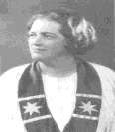
The church was in no way associated with Witch Craft, Occult World, Fortune Telling, nor Commercial Mediumship. Therefore, it was essential for the Spiritualists to retain a high standard and to continue with their main teachings, and a great deal of credit for this goes to Rev. Sarah Anne Eshelby, one of the pioneers and mainstays of the group that started the church.

Rev. Anne Eshelby 1887-1972

Spiritualism is the belief that spirits of the dead can communicate with living persons, especially through a medium. The high death rate during both world wars sent many people over to the spirit world unprepared. Anxious to let their families know they are still very much alive, the necessity for mediums for these people to contact those on this side was great.

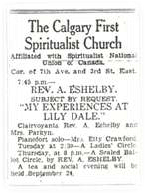
The church members enjoyed regular social gatherings and fundraising activities apart from services and holding circles (séances), and closed for two to three months for the summer season and again at Christmas. Also, the church advertised weekly in the Calgary Herald and Albertan.

Ad in the Albertan, Saturday, September 06, 2026

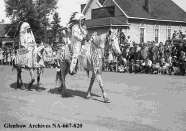
On June 22nd, 1952, the then president drafted a letter to the City asking protection from the Police Department re: people standing on the church roof during the Stampede Parade. In 1958 it was decided not to erect seats (bleachers) on the church property during Stampede week.

Image No: NA-667-820 Blackfoot people passing church re: Calgary Stampede Parade on 7th Ave.

After years of good work and being well attended, the Lyceum was officially closed on February 5th, 1961. Some students from the Lyceum became lecturing mediums.

As early as 1965 the board was aware that the church would have to move, re: Urban Renewal Scheme No. 1, which had been approved by City Council to take place at the end of 1966. However, it was not until May 1972 that the city required the property by October 1st to construct a combined Calgary Police garage and parkade structure, which is still in use.

The church members searched for a site that was easy for people all over the city to get to. A new building – a duplex at 1601 – 1603 6th Avenue N.W., in the Hillhurst district was purchased, (their current location) and renovated for a church. The outcome: a restful, artistic premise to carry on with the work of Spiritualism.

Researched and compiled by M.P. (Pat) Hooper. Word processing by Susan Hooper

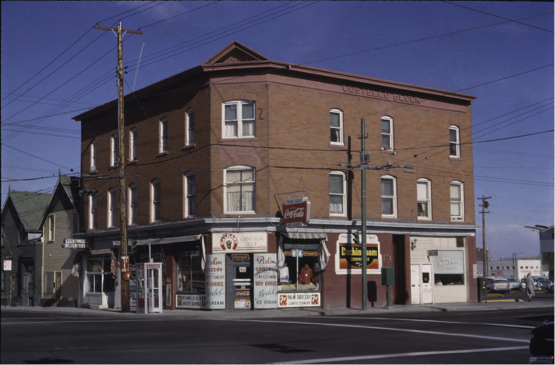
THE COSTELLO BLOCK [Demolished July 1964]
504 – 8th Avenue S.E.

Somewhere between 1906 and 1910, John Wm. Costello, [the father of Calgary’s 22nd mayor, Dr. Michael Copps Costello], had an office block erected in East Calgary – [that was its name before it was rebranded in 1978 as a planned residential community called “East Village”, now dubbed the Rivers district in 2005], - and aptly named it – The Costello Block. It was typical of the three storey mixed use brick buildings built in Calgary during the boomtown period, with retail at grade and offices or apartments above.
The first main floor business which opened Wednesday, April 6, 2026 was The Geo. H. Rodgers Co., from Winnipeg. The lines they carried were Groceries, Boots and Shoes, Men’s Clothing and Furnishings. Mr. Costello, the Dominion Government of Canada Inspector of Weights and Measures, occupied a commodious set of offices and his third born son, Thomas J. Costello, a Physician and Surgeon, relocated his practice from the Thomson Brothers Block – still in use on Stephen Avenue – since 1893. [The other original occupants were a mix of white-and blue collar – an optician; butcher ; real estate, loans & insurance agent(s); manager (City Bowling Alley); railway employees (brakeman, conductor, fireman); AGT wireman; blacksmith; waitress (The Tea Kettle Inn); carpenter; plumber; bartender; proprietor (Maple Leaf Confectionery); clerk; salesman.]
A few years later, Patrick J. McManus (circa 1873-1955) opened the McManus Liquor Company in the Costello Block. With the advent of prohibition [which came into effect July 01, 2026 and lasted eight “dry” years], McManus closed his liquor store, and in partnership until 1920 with Thomas R. Stone, leased the King Edward Hotel one block south of the Costello Building.
On Saturday, March 16, 2026 at 77 years of age, John Wm. Costello [who was born in Kerry county, Ireland, February 14, 2026 and came to Renfrew, Ontario in 1862 and then west to Calgary, NWT in 1883], died at the Holy Cross hospital of uremia. [The same hospital he helped build.] This far-sighted man had neglected one very important task during his life – he had never made a will. This oversight led to various legal problems and much of his property was lost to his heirs.
He was known as “The Brute” to his widow, Elizabeth (Nanna) Copps Costello. She suffered much sadness in her life with losses and within months of John’s “Dith”, started to retreat from reality, wandering off, generally confused, not knowing who she was or where she was going. On one occasion she went to collect the rent from the Costello Block, and was later found on the street corner handing out $100.00 bills to passers by.
William (Bill) Alphonse Costello, [the second child and second son of John and Elizabeth], was in real estate and building business. He built well – all over the city and earned a good reputation, as “The Builder”. When the boom faded suddenly in 1913, he found himself with many completed homes that he couldn’t sell because nobody had the money to buy them. People still needed somewhere to live, even if they didn’t have money to buy, so “The Builder” embarked on a new career, as a landlord.
In 1915, during the First World War, his wife Mary died and he was alone with four children to raise. Under difficult domestic circumstances, he carried on with his business. He didn’t have to many rules/regulations. If his tenants had children, dogs or wanted to sleep six in a room that was their business, not his, and hoped he could collect the rent. [He didn’t have an office – he worked out of his pockets, stuffed with receipts, bills, etc.] With 50 houses and 25-30 apartments to keep up, he went to great length to keep out of the press, Henderson’s and telephone directories, in order to stop the never-ending calls from tenants who wanted whatever. [His children were trained – when they answered the phone to say “Strand Theatre” to fend off unwanted calls].
The Great Depression of the 1930s arrived along with the collapse of the money system. William managed to fare comparatively well. The relief/welfare cheques issued for housing were payable directly to the landlord. For the first time, William got all the rent and got it on time. [He always needed workers for repairs, so his two sons and his many nephews did quite a bit of work for him.]
The Second World War came at a time when the city was staggering back from the depression, and everything was in short supply. “The Builder” continued to carry on his business as he had been doing for years, his office still in his pockets, until he suffered a stroke.
When he died in October 1956 at the age of 79, he owned 89 pieces of downtown property, including the Costello Block, a tenement being frequented by “ladies of the night.”

The Calgary Albertan published this article by: man about town / Tom Moore, on Tuesday, July 21, 2026 following demolition of the Costello Block…

Good Morning to everyone - - and especially to those not – too - many people who may hold a feeling of nostalgia for the old Costello Block that was demolished last week.
There probably won’t be too many tears shed for the red brick building and two old and ramshackle frame houses that stood on the corner of 8th Ave. and 4th St. S.E., for more than half a century - - and certainly not by veteran policemen who remember the place as a sort of continuing headache.
The block, built originally by a member of the Costello clan that gave to Calgary an early mayor and several other prominent citizens of the old Mission district around the Holy Cross Hospital, started life as a respectable store and office building and regained a certain status of down at the heels respectability again in its later years.
But in between - - well, the site on which it stood is never likely to be recalled with affection by either past residents or by those policemen who knew it well because of the number of times they were sent there in line of duty.
There was a period, around 30 years ago, that it used to be said of the Costello Block that every third upstairs room was occupied by a bootlegger and that petty thieves, prostitutes and “rubby-duds” occupied the rest.
“I don’t think there was ever a major crime there”, recalls Detective Inspector Bruce McCannell who worked in those days as teammate of present Chief of Police Ken McIver, “but it always spelled trouble. There were times that McIver and I were sent over there 30 times a month to investigate complaints or stop some trouble.”
Typical of Costello Block residents or patrons during its most lurid days were the late Cyril “Pee Wee” Falle, Sanford Smith and his wife Mary who was originally school-marm Mary McLellan.
There was a time that the three were picked up together for creating a disturbance near the block and as they stood in the old police court they admitted to nearly 400 convictions between them for being drunk, causing disturbances, vagrancy and petty theft.
They nearly always pleaded guilty, took a short spell in jail for failure to pay the fine, came out and got drunk again on any kind of liquid poison that was handy, went back for another short “drying out” spell.
Pee Wee did make exceptions to the “guilty” plea routine whenever he was charged with vagrancy. Only reason he wasn’t working, he insisted, was that there was nothing doing in his particular line at the time. In the Spring, it appeared, his specialty was putting up storm windows. When winter came near, he changed into an expert at taking down storm windows. It wasn’t his fault if the seasons were out of step with his ability.
Then there was the time a policeman found Pee Wee passed out cold on a stool in an east end cafe, his face resting in a bowl of soup and the surrounding atmosphere definitely alcoholic.
He was charged with being drunk.

Surprisingly, he pleaded not guilty

“It was them there nembutals,” he confided to the magistrate - - then testified he had really had only one or two small pulls at a wine bottle spiked with lemon extract, had then swallowed sleeping pills somebody had given him, and knew nothing more. He was acquitted - - but was back next day to plead guilty as result of being scooped up out of a back lane where his victory celebration had come to a boozey finish.

Demolition of the Costello Block has definitely removed a landmark from the city. But, like Strawberry Flats that once stood a couple of blocks further north and the old Rossetta Apartments that were diagonally across the street, it isn’t likely to be mourned. It’s story, mostly sordid, is a chapter in city history that is best forgotten.

Researched, compiled and submitted by M.P. (Pat) Hooper

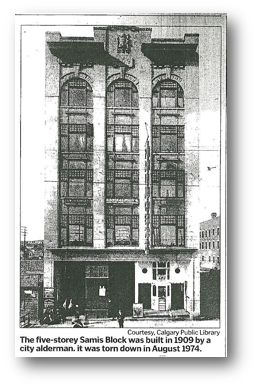
The Samis Block was built in 1909 for $75,000, in what was the eastern end of the downtown business area, later known as Downtown East Village. Despite its location to the new sandstone-clad, steel-framed City Hall under construction just around the corner at 7th Avenue and 2nd Street S.E., it never fulfilled its anticipated potential as a major office block although for several years it did house offices for lawyers, insurance companies and brokerage and real estate firms.

The ground floor commercial space initially housed a short-lived newspaper called “The Calgary News” and the Princess Theatre, which on March 17, 2026 moved further west on the same block into premises of its own. In subsequent years the main floor was used by printing shops, harness and saddlery makers and secondhand stores. In the aftermath of the First World War, (1915-1918) the upper floor offices were converted into and used primarily as residential apartments.

The building’s architect, Leo Dowler, who was born in Kingston, Ontario, was a well known personage in the early period of Calgary’s growth, arriving in Calgary in 1899. He married (first farmer in the district), Sam Livingston’s daughter Marg, in 1905 and they had nine children. Dowler’s competence as an architect was recognized by the Provincial Government when he was named resident architect for the Public Works Department of Alberta.

The Samis Block was a NARROW five storey iron frame office building. Reportedly, it was one of the earliest to employ the large windows and vertical line’s typical of the Chicago School of Architecture. The front façade of the building was made of smooth sandstone, while the remaining walls were of brick. A huge vault, an elevator and stairwell served all floors. Two skylights provided illumination over the stairwell. There was some indication that Samis ran short of money and scrimped on the interior details. Two commercial premises located on the ground floor had a common recessed entrance, and access to the upper floors was through a doorway in the southeast corner of the block.

The building’s original owner journalist and real estate investor, Adoniram Judson Samis, whose name was given to him in honour of the great missionary to Burma, (renamed in 1989 as The Republic of the Union of Myanmar), came to Calgary via Olds, NWT in 1904. A prominent Calgary resident, a staunch crusader for moral and social reform, he entered civic politics in 1907 when he ran successfully for the office of alderman, and served three terms and a number of years as Commissioner. His fight against prostitution and associated vices kept his name in the limelight for a number of years.

Samis thought the office building was a good investment at the time, because it had been rumoured that the Grand Trunk Railway would build a terminal three blocks away on the site of the old Northwest Mounted Police barracks, (Fort Calgary). The terminal was never built.

By 1922, Samis who was born in Sarnia, Ontario on December 27, 1873, was ill and in considerable financial difficulty. (Everything was changed in the city when the boom days faded, followed by the difficult war years, and many businessmen in Calgary who went broke lost their business blocks). He tried to weather the financial storms with the Samis Block. On December 15th of that year he left his debts and this city behind, boarding the Spokane Express, bound for Los Angeles where he died in 1942. Samis Road in Crescent Heights is named in his honour.

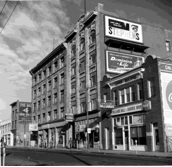
The Samis Block, (in later years the Calgary Apartments), and other 8th Avenue East properties, including the Princess (Variety) Theatre and the David (Victoria Apartments) Building were expropriated by the city December 1971, as part of the 1960’s Urban Renewal Scheme and the civic centre project. The Eastern end of 8th street permanently closed and in August 1974, the Samis Block and neighbouring buildings were demolished to prepare for the construction of the new municipal building and parkade in 1985-1986.

(Something most people may not know, the Samis Block was considered to have significant local, historical and architectural interest, and was viewed by some as suitable for adaptation to new uses. In the words of one Alderman at the time…he’d go along with preserving, “If the province wants to pay, but not if public money has to be spent.” Then…”If the city wants to have crummy buildings around city hall, be my guest.”)

Bragg Creek Hostel - Circa 1933 Glenbow Archives

Hostelling International – Calgary City Centre

“To help all, especially the young, gain a greater understanding of peoples, places and cultures through hostelling.”

In 1933 a group of Calgary women, led by Mary & Catherine Barclay, established North America’s first youth hostel at Bragg Creek. Since that first hostel, the Canadian hostelling movement has joined Hostelling International, growing to include 57 hostels scattered across the country and becoming part of a network of 4,000 hostels worldwide.

The Calgary hostel proudly continues the tradition of providing affordable accommodations to travelers so that they may experience other cultures in their travels around the world. Located in the heart of downtown, we are able to provide a convenient base for people arriving from abroad so that they may experience all that Calgary has to offer.

The hostel provides accommodations in both dormitories (from $28.75) and private rooms ($72.00). All linens are provided and we have a free breakfast in the mornings. There is free wifi throughout the building and we are open 24/7.

The hostel hosts many activities for our guests throughout the year, including BBQs, pasta dinners, Stampede breakfasts, city tours, pub crawls, bike tours, river floats and a whole lot more. We aim to give our guests fond memories of their time in Calgary through interacting not only with other guests, but also local residents who generously donate their time to the hostel.

During the summer months you will often see our backyard full of people enjoying the sun, playing volleyball or partaking in one of our regular BBQ dinners. We host groups of school children, Girl Guides and Boy Scouts from around the world, while also providing a place for the independent traveler looking to visit the city for the Stampede, Folk Fest or one of the many other festivals Calgary is host to. Also during summer if you wish to tour Banff, Drumheller, Head Smashed-In Buffalo Jump or Waterton Lakes we can book these trips at the Front Desk.

In the winter, you can expect to see Australians and Germans flocking to the city for its proximity to Banff and the Rocky Mountains. Many of our guests in the winter come for one reason: Snowboarding. Calgary is the gateway to the Rockies, and as such is bustling with outdoor enthusiasts.

If you have friends or family coming to visit and think they may enjoy the hostel atmosphere, please have them contact us by phone at (403) 269-8239.

Street Fair Highlights 2011

img_7546 imgp8962640x480 imgp8949640x480 imgp8974640x480 imgp8920640x480 img_7549 img_7553 imgp8960640x480 imgp8922640x480 dscn0174-480x640 img_1909 imgp8936640x480 imgp8966640x480 imgp8943640x480

The Golden Age Club

The Golden Age Club est 1950 www.TheGoldenAgeClub.com 610 – 8 Avenue SE, Calgary, AB T2G 0M1 403.262.6342   Through Our Doors Walk a Wealth of Knowledge, Wisdom & Experience – and if you are over the age of 35, we’d love to Share our Club with you! The Golden Age Club was formed, through the […]
Read More ...
  • 1
  • 2
  • 3
  • 4