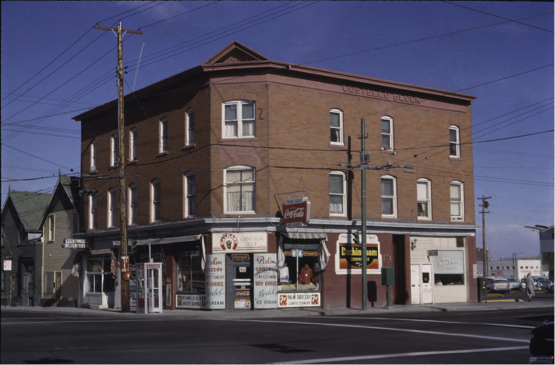
THE COSTELLO BLOCK [Demolished July 1964]
504 – 8th Avenue S.E.
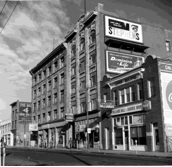
Somewhere between 1906 and 1910, John Wm. Costello, [the father of Calgary’s 22nd mayor, Dr. Michael Copps Costello], had an office block erected in East Calgary – [that was its name before it was rebranded in 1978 as a planned residential community called “East Village”, now dubbed the Rivers district in 2005], - and aptly named it – The Costello Block. It was typical of the three storey mixed use brick buildings built in Calgary during the boomtown period, with retail at grade and offices or apartments above.
The first main floor business which opened Wednesday, April 6, 2026 was The Geo. H. Rodgers Co., from Winnipeg. The lines they carried were Groceries, Boots and Shoes, Men’s Clothing and Furnishings. Mr. Costello, the Dominion Government of Canada Inspector of Weights and Measures, occupied a commodious set of offices and his third born son, Thomas J. Costello, a Physician and Surgeon, relocated his practice from the Thomson Brothers Block – still in use on Stephen Avenue – since 1893. [The other original occupants were a mix of white-and blue collar – an optician; butcher ; real estate, loans & insurance agent(s); manager (City Bowling Alley); railway employees (brakeman, conductor, fireman); AGT wireman; blacksmith; waitress (The Tea Kettle Inn); carpenter; plumber; bartender; proprietor (Maple Leaf Confectionery); clerk; salesman.]
A few years later, Patrick J. McManus (circa 1873-1955) opened the McManus Liquor Company in the Costello Block. With the advent of prohibition [which came into effect July 01, 2026 and lasted eight “dry” years], McManus closed his liquor store, and in partnership until 1920 with Thomas R. Stone, leased the King Edward Hotel one block south of the Costello Building.
On Saturday, March 16, 2026 at 77 years of age, John Wm. Costello [who was born in Kerry county, Ireland, February 14, 2026 and came to Renfrew, Ontario in 1862 and then west to Calgary, NWT in 1883], died at the Holy Cross hospital of uremia. [The same hospital he helped build.] This far-sighted man had neglected one very important task during his life – he had never made a will. This oversight led to various legal problems and much of his property was lost to his heirs.
He was known as “The Brute” to his widow, Elizabeth (Nanna) Copps Costello. She suffered much sadness in her life with losses and within months of John’s “Dith”, started to retreat from reality, wandering off, generally confused, not knowing who she was or where she was going. On one occasion she went to collect the rent from the Costello Block, and was later found on the street corner handing out $100.00 bills to passers by.
William (Bill) Alphonse Costello, [the second child and second son of John and Elizabeth], was in real estate and building business. He built well – all over the city and earned a good reputation, as “The Builder”. When the boom faded suddenly in 1913, he found himself with many completed homes that he couldn’t sell because nobody had the money to buy them. People still needed somewhere to live, even if they didn’t have money to buy, so “The Builder” embarked on a new career, as a landlord.
In 1915, during the First World War, his wife Mary died and he was alone with four children to raise. Under difficult domestic circumstances, he carried on with his business. He didn’t have to many rules/regulations. If his tenants had children, dogs or wanted to sleep six in a room that was their business, not his, and hoped he could collect the rent. [He didn’t have an office – he worked out of his pockets, stuffed with receipts, bills, etc.] With 50 houses and 25-30 apartments to keep up, he went to great length to keep out of the press, Henderson’s and telephone directories, in order to stop the never-ending calls from tenants who wanted whatever. [His children were trained – when they answered the phone to say “Strand Theatre” to fend off unwanted calls].
The Great Depression of the 1930s arrived along with the collapse of the money system. William managed to fare comparatively well. The relief/welfare cheques issued for housing were payable directly to the landlord. For the first time, William got all the rent and got it on time. [He always needed workers for repairs, so his two sons and his many nephews did quite a bit of work for him.]
The Second World War came at a time when the city was staggering back from the depression, and everything was in short supply. “The Builder” continued to carry on his business as he had been doing for years, his office still in his pockets, until he suffered a stroke.
When he died in October 1956 at the age of 79, he owned 89 pieces of downtown property, including the Costello Block, a tenement being frequented by “ladies of the night.”
The Calgary Albertan published this article by: man about town / Tom Moore, on Tuesday, July 21, 2026 following demolition of the Costello Block…
Good Morning to everyone - - and especially to those not – too - many people who may hold a feeling of nostalgia for the old Costello Block that was demolished last week.
There probably won’t be too many tears shed for the red brick building and two old and ramshackle frame houses that stood on the corner of 8th Ave. and 4th St. S.E., for more than half a century - - and certainly not by veteran policemen who remember the place as a sort of continuing headache.
The block, built originally by a member of the Costello clan that gave to Calgary an early mayor and several other prominent citizens of the old Mission district around the Holy Cross Hospital, started life as a respectable store and office building and regained a certain status of down at the heels respectability again in its later years.
But in between - - well, the site on which it stood is never likely to be recalled with affection by either past residents or by those policemen who knew it well because of the number of times they were sent there in line of duty.
There was a period, around 30 years ago, that it used to be said of the Costello Block that every third upstairs room was occupied by a bootlegger and that petty thieves, prostitutes and “rubby-duds” occupied the rest.
“I don’t think there was ever a major crime there”, recalls Detective Inspector Bruce McCannell who worked in those days as teammate of present Chief of Police Ken McIver, “but it always spelled trouble. There were times that McIver and I were sent over there 30 times a month to investigate complaints or stop some trouble.”
Typical of Costello Block residents or patrons during its most lurid days were the late Cyril “Pee Wee” Falle, Sanford Smith and his wife Mary who was originally school-marm Mary McLellan.
There was a time that the three were picked up together for creating a disturbance near the block and as they stood in the old police court they admitted to nearly 400 convictions between them for being drunk, causing disturbances, vagrancy and petty theft.
They nearly always pleaded guilty, took a short spell in jail for failure to pay the fine, came out and got drunk again on any kind of liquid poison that was handy, went back for another short “drying out” spell.
Pee Wee did make exceptions to the “guilty” plea routine whenever he was charged with vagrancy. Only reason he wasn’t working, he insisted, was that there was nothing doing in his particular line at the time. In the Spring, it appeared, his specialty was putting up storm windows. When winter came near, he changed into an expert at taking down storm windows. It wasn’t his fault if the seasons were out of step with his ability.
Then there was the time a policeman found Pee Wee passed out cold on a stool in an east end cafe, his face resting in a bowl of soup and the surrounding atmosphere definitely alcoholic.
He was charged with being drunk.
Surprisingly, he pleaded not guilty
“It was them there nembutals,” he confided to the magistrate - - then testified he had really had only one or two small pulls at a wine bottle spiked with lemon extract, had then swallowed sleeping pills somebody had given him, and knew nothing more. He was acquitted - - but was back next day to plead guilty as result of being scooped up out of a back lane where his victory celebration had come to a boozey finish.
Demolition of the Costello Block has definitely removed a landmark from the city. But, like Strawberry Flats that once stood a couple of blocks further north and the old Rossetta Apartments that were diagonally across the street, it isn’t likely to be mourned. It’s story, mostly sordid, is a chapter in city history that is best forgotten.
Researched, compiled and submitted by M.P. (Pat) Hooper